Spegazzini Glacier: Complete Guide 2026
The highest glacier in Los Glaciares National Park

Last update:
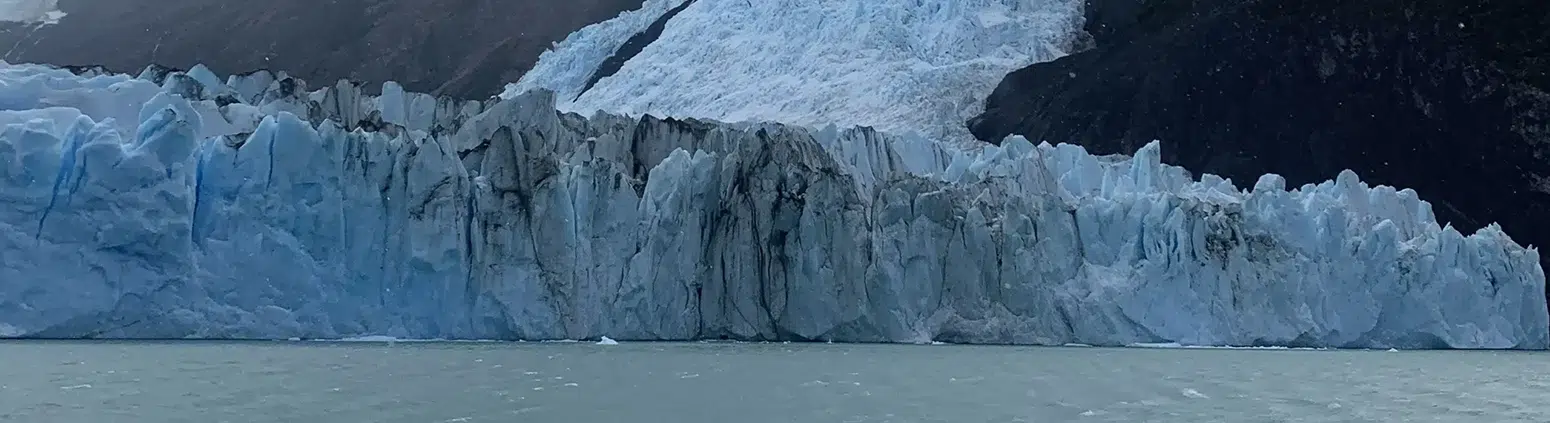
The Spegazzini Glacier is the tallest of Los Glaciares National Park: its vertical ice front reaches the 135 meters above the level of Lake Argentino, which makes it one of the most impressive glacial walls in the world. Unlike the Upsala Glacier The Spegazzini volcano—the largest in the park—is notable for its verticality rather than its surface area. It shares the North Arm of Lake Argentino with Upsala and is a must-see destination on boat trips. El Calafate.
| Location | Spegazzini Bay, North Arm of Lake Argentino, Los Glaciares National Park, Santa Cruz, Argentina |
|---|---|
| Coordinates | 50°25′S 73°15′W |
| Access from El Calafate | Only accessible by boat from Puerto Punta Bandera (~50 km from El Calafate) |
| Surface | ~135 km² |
| Front height | 135 meters above the lake — the tallest in the park |
| Origin | Southern Patagonian Ice Field |
| UNESCO World Heritage Site | Yes, within Los Glaciares National Park (1981) |
| State | Relatively stable, unlike the Upsala |
| How to visit it | Navigation only (All Glaciers or Gourmet Glaciers) |
Where is the Spegazzini Glacier located?
The Spegazzini Glacier is located in the Spegazzini Bay, in the North Arm of Lake Argentino, within the Los Glaciares National Park, in the province of Santa Cruz, Argentine Patagonia. It shares a location with the Upsala GlacierBoth are located in the same arm of the lake and are the two main attractions of the navigations through the northern area.
Like the Upsala, the Spegazzini It has no land access. The only way to reach his forehead is through navigation on Lake Argentino, starting from Puerto Punta Bandera, about 50 km from the city of El Calafate.
Map and geographical location
The glacier originates in the Southern Patagonian Ice Field, on the border with Chile, and flows eastward until it empties into Spegazzini Bay. Its approximate coordinates are 50°25′ South and 73°15′ West. It is surrounded by vertical rock walls that frame its distinctive ice face, creating one of the most spectacular glacial landscapes on the continent.
Characteristics of the Spegazzini Glacier
The most distinctive feature of the Spegazzini is its height. While the Perito Moreno Glacier reaches 60-70 meters above the lake level, the Spegazzini Glacier reaches... 135 meters, almost double. It is the highest glacier in Los Glaciares National Park and one of the highest of its kind in the world.
It was named in honor of Carlos Luis Spegazzini, Italian naturalist who settled in Argentina at the end of the 19th century and was one of the first scientists to study the flora and fauna of southern Patagonia.
Height and verticality
The ice face of Spegazzini rises above Lake Argentino like a vertical wall of blues and whites. This feature makes it especially photogenicEven viewed from the distance that commercial shipping must maintain for safety, its visual size is striking. It is the glacier that generates the most photos in proportion to the exposure time during excursions.
Surface area and volume
With an area of approximately 135 km², the Spegazzini is much smaller than the Uppsala (840 km²) but similar in size to the Perito Moreno (250 km²). Its ice volume is difficult to estimate because a large part of the glacier is located between steep rock walls that have not been accurately mapped.
Glacier stability
Unlike the Upsala —which is in clear decline—, the Spegazzini remains relatively stable in recent decades. Its geometry (steep walls, firm bedrock) and the mass balance of its catchment basin explain this difference. It doesn't advance like the Perito Moreno nor does it retreat sharply like the Upsala: it remains in an intermediate zone.
How to visit the Spegazzini Glacier from El Calafate
The only way to see the Spegazzini Glacier is by navigation From Puerto Punta Bandera, about 50 km from El Calafate. The excursions that include it are the same ones that go to the Upsala —both glaciers are in the same North Arm— and are done in the day.
All Glaciers Navigation
The All Glaciers excursion This is the most popular option for visiting Spegazzini. It's a full-day boat trip (approximately 9 hours including transfers) that takes you past three glaciers on the North Arm: Uppsala, Spegazzini and Onelli. The boat approaches the Spegazzini wall so that passengers can appreciate the verticality of the ice from the water.
For many visitors, the Spegazzini is the most impressive moment of the tour, precisely because of its height.
Gourmet Glacier Navigation
The Gourmet Glaciers Navigation It covers the same route (Upsala and Spegazzini) on a smaller vessel, with premium onboard dining and a more leisurely pace in front of each glacier. It's the recommended option for those who prioritize comfort and photography.
What to bring on the voyage
Although most of the tour is done from the boat, you should be able to go on deck to photograph the Spegazzini from below (the angle that best takes advantage of its height). We recommend: a waterproof and windproof jacket, a fleece, a hat, thin gloves, sunglasses, sunscreen, and a camera with a good wide-angle lens. The wind on the lake can be strong even in summer.
Book your boat trip to the Spegazzini Glacier
Spegazzini Glacier vs Upsala vs Perito Moreno
The park's three most visited glaciers have very distinct personalities. This comparison helps you understand what to expect from each one:
| Feature | Spegazzini | Uppsala | Perito Moreno |
|---|---|---|---|
| Surface | ~135 km² | 840 km² (the largest) | 250 km² |
| Front height | 135 m (the highest) | ~60 m | ~70 m |
| Access | Navigation only | Navigation only | Footbridges + navigation |
| State | Stable | In retreat | In equilibrium (advances ~2 m/day) |
| Main attraction | Verticality and ice wall | Giant icebergs | Proximity to the front and landslides |
| Typical excursion | Todo Glaciares | Todo Glaciares | Tour of the Catwalks |
The Spegazzini is usually the positive surprise Regarding the sailing trips: many visitors come thinking of the Upsala (more famous) and leave with the Spegazzini as their best memory, precisely because of the spectacular height seen from the water.
Best time to visit the Spegazzini Glacier
As with all glaciers accessible only by boat, the critical factor is the climate over Lake Argentino. The peak operating season runs from September to April, and each season has its own particularities:
| Time | Months | Climate | Advantages | Things to keep in mind |
|---|---|---|---|---|
| Summer | Dec-Feb | 8-17°C, long days | Better weather, guaranteed navigation, all services operational | High demand, book in advance |
| Autumn | Mar-May | 2-10°C, autumn colors | Fewer tourists, spectacular scenery | May: Some sailings reduce frequency |
| Winter | June-August | -2 to 5°C | Intimate experience, snowy glacier | Limited sailings, higher risk of cancellation due to wind |
| Spring | Sep-Nov | 4-12°C, long days | Fewer people, good weather, low prices | Strong winds some days |
The wind over Lake Argentino This is the factor that can cancel sailing trips. On days with strong winds (more frequent in spring), boats may suspend departures for safety reasons. It's advisable to be flexible with your dates and, if possible, consider booking your sailing trip at the beginning of your stay so you can reschedule if it's canceled.
History and name of the Spegazzini Glacier
The glacier was named in honor of Carlos Luis Spegazzini (1858-1926), an Italian naturalist born in Bairo, Italy, who arrived in Argentina in 1879 and settled in La Plata. He was one of the first botanists and mycologists to systematically study the flora of southern Patagonia, describing hundreds of species new to science.
Spegazzini participated in several scientific expeditions to the area of what is now Los Glaciares National Park at the beginning of the 20th century. His work in classifying Patagonian fungi remains an essential reference a century later.
The naming of the glacier after him was a recognition of his contribution to the knowledge of Patagonian nature, and is part of an Argentine tradition of honoring scientists in geographical features of the far south (such as Perito Moreno, Onelli, Ameghino or Heim).
Flora and fauna in the Spegazzini area
The area around Spegazzini is one of the most pristine in the park due to its limited access. The rocky walls that frame the glacier are a natural nesting ground for... Andean condors, They fly over the area searching for thermal currents. It is one of the best areas of Los Glaciares National Park for spotting condors in flight.
They grow on the coasts and in nearby forests lenga, ñire and guindo trees, The three dominant tree species of the Andean-Patagonian forest. At the base of the glacier and in the surrounding moraines, several species described by Carlos Luis Spegazzini have been documented, adding a historical layer to the route.
Rainbow and brown trout inhabit the waters of the North Arm. Larger wildlife (huemul deer, pumas) is present but very elusive due to limited human access to the area.
Tips for your navigation to the Spegazzini Glacier
- Book in advance: During peak season (December-February) places sell out 2-3 weeks in advance.
- Be flexible: The sailing trip may be cancelled due to strong winds. If your itinerary allows, schedule the excursion at the beginning of your stay to allow for rescheduling.
- Point the camera upwards: The Spegazzini is vertical, not horizontal. The best photos require angles that take advantage of its height. Use a wide-angle lens or switch to panoramic mode.
- Dress in layers: Even in summer, the wind across the lake makes it feel cooler. Bring a raincoat, fleece, hat, and thin gloves.
- Sunscreen and sunglasses: The reflection of ice and water intensifies UV radiation, even on cloudy days.
- Charge battery: The boat trip takes approximately 9 hours, including transfers. Bring a power bank if you plan to take a lot of photos or videos.
- Combine it with the Upsala: Both are on the same arm and can be visited together in Todo Glaciares. There's no point in going for just one.
Frequently Asked Questions about the Spegazzini Glacier
Where is the Spegazzini Glacier located?
The Spegazzini Glacier is located in the Spegazzini Bay, It is located in the North Arm of Lake Argentino, within Los Glaciares National Park, in the province of Santa Cruz, Argentine Patagonia. Its approximate coordinates are 50°25′S 73°15′W. It has no land access: it can only be visited by boat from Puerto Punta Bandera, located about 50 km from the city of El Calafate.
How big is the Spegazzini Glacier?
Its most impressive feature is the front heightThe ice face reaches the 135 meters above the level of Lake Argentino, This makes it the tallest glacier in Los Glaciares National Park. Its surface area is approximately 135 km², much smaller than the Upsala (840 km²) but similar to the Perito Moreno (250 km²).
How to visit the Spegazzini Glacier?
The Spegazzini Glacier can only be visited by navigation. The two main excursions are: sailing Todo Glaciares (~9 hours, visiting Upsala, Spegazzini and Onelli) and the Glaciares Gourmet (premium version with onboard dining). Both depart from Puerto Punta Bandera, about 50 km from El Calafate, and include ground transportation from the city.
What is the difference between the Spegazzini Glacier and the Upsala Glacier?
The Uppsala is more extensive (840 km² vs 135 km²) and is characterized by its giant icebergs that break off and float across the lake. Spegazzini is tallerIts 135-meter vertical face is the tallest ice wall in the park. The Upsala is in clear retreat; the Spegazzini remains relatively stable. They are complementary and are visited together on the same boat trip.
What is the difference between the Spegazzini and the Perito Moreno?
The Perito Moreno is accessible by land (It has walkways) and is maintained in dynamic equilibrium (it advances ~2 meters/day and produces frequent landslides). The Spegazzini can only be visited by boat, Its face is almost twice as high (135 m vs ~70 m) and more stable. Perito Moreno is more accessible from the ice; Spegazzini is impressively tall in its vertical scale.
When is the best time to see the Spegazzini Glacier?
The best time is October to March, when the days are long and the temperatures are more pleasant. The critical factor is the wind over Lake ArgentinoOn days with strong winds (more frequent in spring) sailing may be cancelled for safety reasons, so it is advisable to be flexible with dates.
Why is it called the Spegazzini Glacier?
The glacier was named in honor of Carlos Luis Spegazzini (1858-1926), an Italian naturalist based in Argentina, was one of the first scientists to systematically study the flora of southern Patagonia, describing hundreds of species new to science. His work in classifying Patagonian fungi remains a reference today.
How much does a boat trip to the Spegazzini Glacier cost?
Prices vary depending on the excursion and the season. Navigation Todo Glaciares It's the classic option and includes Upsala, Spegazzini, and Onelli in a full day. The version Glaciares Gourmet It has a higher rate for food service. Check the Prices updated 2026 to see the details.