Laguna de los Tres (Fitz Roy): trekking guide from El Calafate
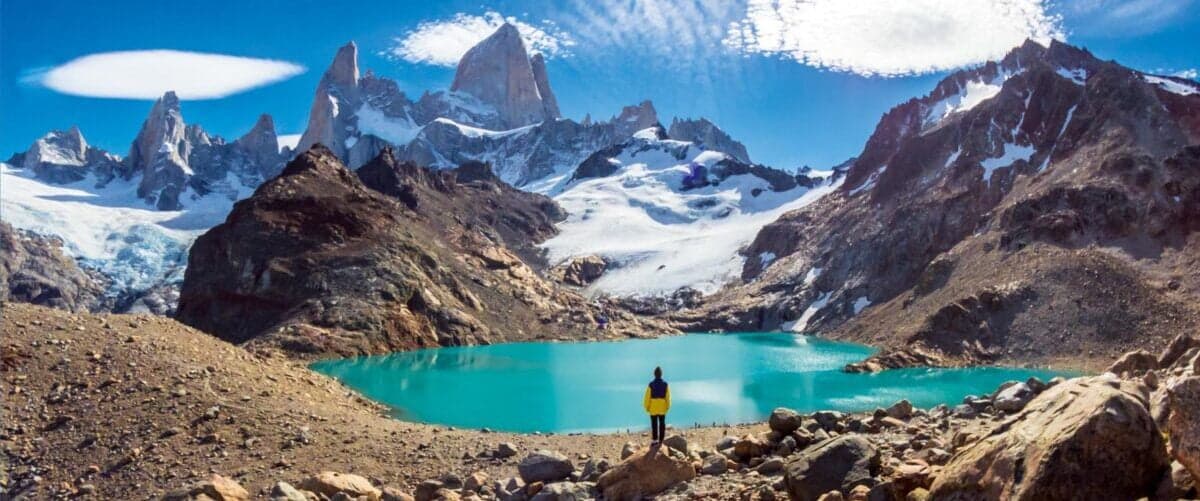
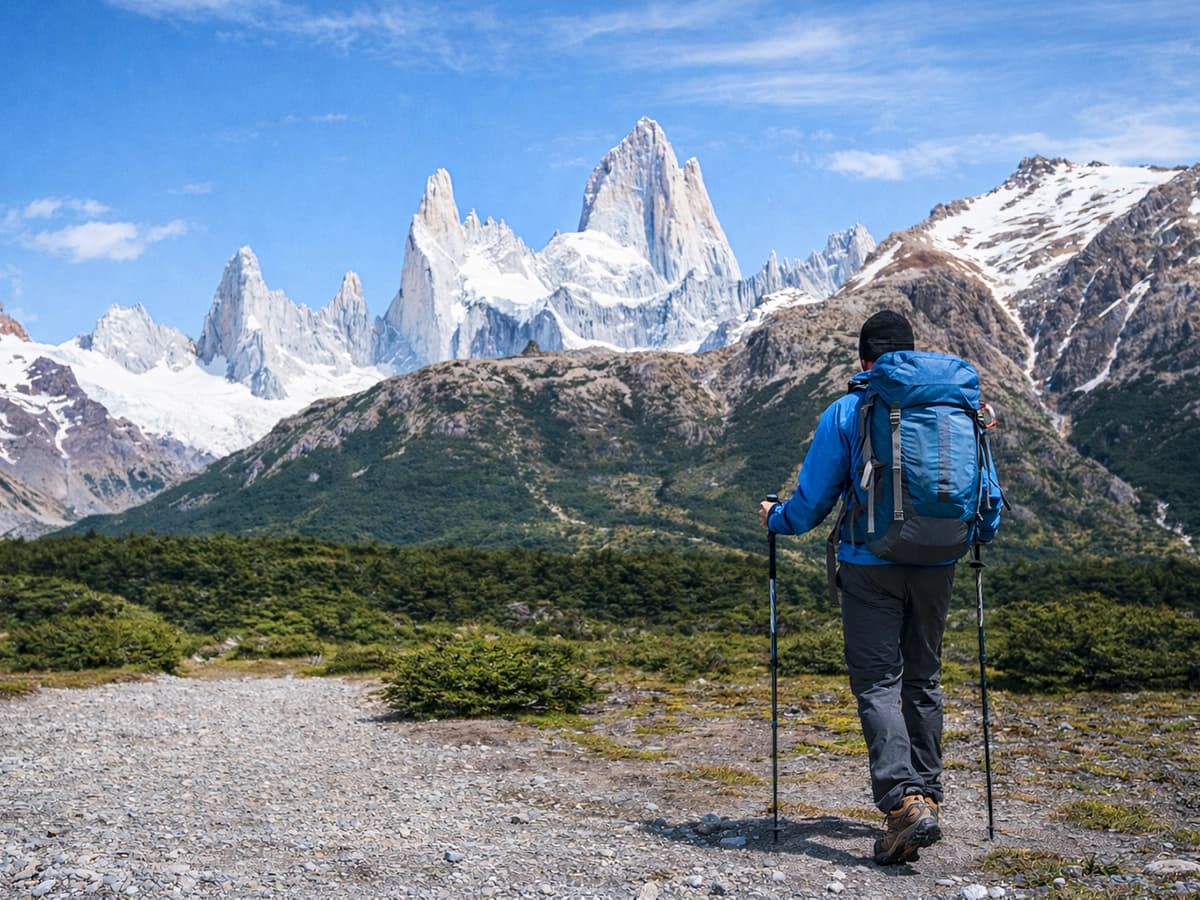
Laguna de los Tres is the end of the most famous trail in Los Glaciares National Park and the classic postcard of Mount Fitz Roy. It's a 20 to 25 km round-trip trek, with about 800–900 m of accumulated elevation gain, a final altitude near 1,200 m above sea level, and 8 to 10 hours of walking. Medium to medium-high difficulty. It starts in El Chaltén, about 215 km and a 3-hour drive from El Calafate.
This guide is written for travelers based in El Calafate who want to understand, without marketing spin, what you can do in a single day, what's better left for an overnight in El Chaltén, and how to put it together. Data cross-checked with the National Parks Administration (APN) and the official El Chaltén site.
Verified technical data
| Data point | Value |
|---|---|
| Round-trip distance | ~20–25 km (depending on where you start in town) |
| Accumulated elevation gain | ~800–900 m |
| Laguna de los Tres altitude | ~1,170–1,200 m a.s.l. |
| Total duration | 8 to 10 h |
| Difficulty | Medium to medium-high (APN) |
| Final stretch | ~1 km with ~400 m of gain over moraine |
| Trail access | Fee-based since 21/10/2024 (APN, online) |
| Best time | November to March |
Sources: APN (argentina.gob.ar/parquesnacionales) and the official-local site elchalten.com. Cross-checked with Wikiexplora (GPS), Welcome Argentina and reputable publications.
What is Laguna de los Tres and why the name?
It's a glacial lake at the foot of the Fitz Roy massif, in the northern zone of Los Glaciares National Park. The name comes from the 1952 French expedition that made the first ascent of Fitz Roy: the "three" are the three main peaks of the Fitz Roy group —Fitz Roy, Poincenot and Saint-Exupéry— that appear reflected behind the lake in the classic postcard.
Climbing up there isn't optional on this trail: the lake sits literally at the foot of the peak, on a glacial moraine, and from its upper edge you look down on Laguna Sucia, another turquoise glacial lake. On a clear day, the Glaciar de los Tres also appears, hanging between the summits.
Trail profile: distance, elevation, altitude and difficulty
How high is Laguna de los Tres?
It's at approximately 1,170–1,200 m above sea level. The starting point (end of Av. San Martín, "Puesto Amarillo", APN trailhead) is at about 402 m, so you climb close to 800 net meters over the day. The last km is the toughest: it packs about 400 meters of gain on a steep slope.
Real difficulty and the last km over moraine
APN rates the trail as medium-high difficulty. The reality: the first 8 km are a long but friendly walk, with gentle climbs and a couple of steeper sections. The last km, from the Río Blanco post to the lake, is the filter: loose moraine, large rocks, natural stone steps and almost always strong wind. Allow at least an hour to climb it and another to come down. If you're tired or the wind is very strong, you can stop at Poincenot camp and enjoy the partial view —that's a legitimate decision, not a failure.
The last kilometer is deceptive: it looks short on the map, but it's the one that costs double. Save energy and water for that final climb and don't tackle it on an empty tank after 8 km of walking.
Stage-by-stage itinerary
| Stage | km from trailhead | Altitude (m) | Cumulative time |
|---|---|---|---|
| APN trailhead (end of Av. San Martín) | 0 | 402 | 0:00 |
| Río de las Vueltas viewpoint | 0.75 | 498 | 0:30–1:00 |
| Laguna Capri turnoff | 3.92 | 763 | 1:45 |
| Laguna Torre trail junction | 7.2 | 729 | 3:00 |
| Poincenot campsite | 8.0 | 742 | 3:30–4:00 |
| Río Blanco / foot of final climb | 8.5–9.0 | 760 | 4:00 |
| Laguna de los Tres | ~10.4 | 1,170–1,200 | 4:30–5:30 |
The Río de las Vueltas viewpoint comes quickly and already gives a huge first photo of the range. Laguna Capri sits 350 m off the main trail and is a worthwhile detour: a small lake with Fitz Roy behind it, ideal for a first lunch stop. Poincenot campsite is the base of the final climb; many hikers rest there 20 minutes before tackling the moraine. From Laguna de los Tres you can skirt it 500–800 m further to the right to peek down at Laguna Sucia: the contrast of the two lakes 200 m apart in altitude is the best photo of the day.
Can you do Laguna de los Tres in a day from El Calafate?
Direct answer: no, unless you're very fit and accept rushing it. The math doesn't add up comfortably.
The bus math
- The earliest bus leaves El Calafate around 08:00 (Chaltén Travel, Cal-Tur, Taqsa) and reaches El Chaltén around 11:00.
- The trail to Laguna de los Tres takes 8 to 10 h round trip, not counting time at the lake or long stops.
- The last reasonable return buses are at 18:00, 19:20 and 19:30.
If you start walking from town at 11:15 and the trek takes you a realistic (not fast) 9 hours, you're back in town at 20:15. You've missed the last bus. And that's if everything goes perfectly: no wind slowing you on the moraine, no lost time on photos, no mild altitude headache. Real margin = 0.
Editorial verdict: from El Calafate, Laguna de los Tres requires at least one night in El Chaltén. We say this as a local operator: we've seen too many travelers running for the last bus or getting stranded.
What DOES fit in a day from El Calafate
If you have a single day and want to see Fitz Roy and get to know El Chaltén, this is realistic:
| Day-trip plan | Walk | What you see |
|---|---|---|
| Mirador de los Cóndores + Mirador de las Águilas (5 km, 2–3 h) | Yes | Panoramic view of the town, valley and Fitz Roy behind |
| Chorrillo del Salto (6 km round trip, 2 h) | Yes | Waterfall in a lenga forest |
| Río de las Vueltas viewpoint (first section of the Fitz Roy trail, ~1.5 km round trip) | Yes | First balcony of the massif |
| Lunch in El Chaltén | — | Town |
Total: ~4 h of actual walking + transfer + lunch, and you're back in Calafate on the 18:00 bus.
Comparison: full day vs 1 overnight vs 2–3 nights
| Plan | Do you reach Laguna de los Tres? | Who it's for |
|---|---|---|
| Full day from Calafate | No (yes to short viewpoints and Chorrillo del Salto) | A single afternoon, no trekking gear |
| 1 overnight in Chaltén | Yes (full trek day + sleeping before and/or after) | Standard traveler with one day to hike |
| 2–3 nights in Chaltén | Yes, with margin for weather + Laguna Torre or Lago del Desierto | Trekkers, photographers, anyone wanting a weather buffer |
How to get to El Chaltén from El Calafate
It's 215 km and about 3 h on a fully paved road (RP 11 + RN 40 + RP 23). There's daily service 365 days a year.
Active bus companies 2025–2026 (verify current): Chaltén Travel, Cal-Tur, TAQSA/Marga and Las Lengas. In high season (Oct–Apr) more departures are added.
If your plan is to climb to the lake, the logical move is to sleep in El Chaltén: we recommend arranging the transfer and overnight separately. If instead you want a guided day with viewpoints included without climbing to the lake, the El Chaltén Full Day + Viewpoints is the honest day-trip option.
Best time to do the trek
| Month | Condition |
|---|---|
| October | APN fee reopens (Oct 1). Possible snow/ice on the last km. Experienced hikers. |
| November | Trail open. Fewer people than January. Strong winds already present. |
| December | Full summer, days up to 16 h of light. Strong wind. |
| January–February | Most stable weather of the year. Peak crowds. Book accommodation 2–3 months ahead. |
| March | Early autumn. Yellow and red forests. Excellent photography. |
| April | Wettest month. APN access suspended on May 1. |
| May–September | Winter: mandatory APN registration. Final stretch often closed or "not recommended". Crampons. Most services closed. |
Local recommendation: November and March offer the best weather/crowds balance. If your priority is stable weather for photos, choose January or February. To dig deeper, see our guide on the best time to visit El Calafate.
What to bring on the trail
- Footwear: waterproof trekking boots with a sturdy sole. The final moraine punishes.
- Layers: a 3-layer system (base + fleece + waterproof windbreaker). The weather changes within hours.
- Water: carry 2 L. There are drinkable streams along the way (Del Salto, Río Blanco). Filter or boil if you draw from below Poincenot due to heavy use.
- Food: a full packed lunch. There are no services on the trail.
- Headlamp with spare batteries (APN explicitly recommends it, don't rely on your phone).
- Sunglasses, sun hat, high-UV sunscreen, warm hat and gloves.
- Trekking poles: highly recommended for the final descent.
Access, APN fee and registration: what changed in 2024
Important change: since 21 October 2024 the trail to Laguna de los Tres and the rest of the northern-zone trails of Los Glaciares NP are no longer free. The ticket is bought online on the APN site (ventaweb.apn.gob.ar), by card only, and there are Flexipass passes of 2, 3 and 7 days valid for the northern (Chaltén) and southern (Perito Moreno) zones.
Access suspended between 1 May and 30 September (low season).
Mandatory APN registration all year for climbing and remote areas; between May and September it's mandatory for all trails, including Laguna de los Tres, at the Ceferino Fonzo Visitor Center in El Chaltén.
Official fees and hours: verify the current ones on the APN site before traveling. For the full breakdown of the 14 trails in the zone and their fees, see our El Chaltén trekking guide.
Laguna Torre vs Laguna de los Tres: which to choose?
These are the two El Chaltén classics, both full-day treks from town.
| Feature | Laguna de los Tres | Laguna Torre |
|---|---|---|
| Round-trip distance | ~20–25 km | ~18 km |
| Elevation gain | ~800–900 m | ~250 m |
| Time | 8–10 h | 6–8 h |
| Difficulty | Medium-high | Medium |
| View | Fitz Roy, Poincenot, Saint-Exupéry, glacial lake, Laguna Sucia | Cerro Torre, Grande glacier, icebergs in the lake |
| When to choose | You want the classic Fitz Roy postcard and have the legs | An easier day, iceberg views, less elevation gain |
If you have two days in El Chaltén, do both: they're different and complement each other.
Frequently asked questions
Frequently asked questions about Laguna de los Tres
Resolvemos las dudas más comunes.
How to plan it from El Calafate with Calafate Tours
We're a local operator based in El Calafate. We don't sell the guided Laguna de los Tres trek because, honestly, the trail is well marked, doing it with a guide doesn't add value proportional to the cost, and most travelers enjoy it more going at their own pace. What we do offer is the logistics to get you there and back:
- I have a single day and won't do the trek → El Chaltén Full Day + Viewpoints. Mirador de los Cóndores, Chorrillo del Salto, Fitz Roy view, lunch, return to Calafate.
- I want to combine Chaltén with Lago del Desierto → El Chaltén + Lago del Desierto + Vespignani Glacier.
- I want to climb to the lake with an overnight → message us on WhatsApp and we'll arrange transfer + accommodation in El Chaltén tailored to you.
Last updated: May 30, 2026. Volatile data (APN fee, bus schedules, campsite rates) verified as of December 1, 2025. Verify the current information before traveling.