History of the Perito Moreno Glacier: Origin, Name, Rupture and Present
The Perito Moreno Glacier is a tongue of ice from the Southern Patagonian Ice Field that descends to Lago Argentino, inside Los Glaciares National Park (Santa Cruz, Argentina). It was named by Lieutenant Alfredo Iglesias in his 1899 survey (1901 report) in honor of Francisco P. Moreno, the boundary expert with Chile who never got to see the glacier. The park was created in 1937 and declared a World Heritage Site by UNESCO in 1981. Its last confirmed rupture was on December 28, 2019.
Here in El Calafate there are two things almost every visitor takes for granted that are false: that "Perito" is Moreno's first name, and that Moreno discovered the glacier. Neither is true. "Perito" was his job title —the expert of the Commission of Limits with Chile— and the man never set foot on or even saw the ice front that today bears his name.
That confusion is a good starting point, because the history of the Perito Moreno Glacier is far more interesting than the postcard: a landscape shaped by the Quaternary glaciations, an indigenous people who roamed this steppe for millennia, a border dispute with Chile that defined the map of Patagonia, a rupture phenomenon broadcast live to the entire world, and a recent twist few brochures mention: the glacier stopped being in equilibrium and began to retreat.
In this guide we tell the complete story, separating proven facts from the myths circulating online. We do it from here, where we watch it all year round.
Quick facts about the Perito Moreno Glacier
The Perito Moreno Glacier sits in Los Glaciares National Park, in the southwest of Santa Cruz province, about 80 km from El Calafate via Provincial Route 11. It is one of the ice tongues of the Southern Patagonian Ice Field and one of the few accessible by land. These are the key facts to orient yourself before diving into the history:
| Fact | Value |
|---|---|
| Location | Los Glaciares National Park, Santa Cruz, Argentine Patagonia |
| Distance from El Calafate | ~80 km via RP 11 (paved) |
| Surface area | ~250 km² |
| Length | ~30 km |
| Width of the front | ~5 km |
| Height of the front above Lago Argentino | 60–74 m |
| Total ice thickness | ~170 m |
| Advance speed | ~2 m/day (up to ~700 m/year in the central sector) |
| Belongs to | Southern Patagonian Ice Field |
| National Park creation | May 11, 1937 |
| UNESCO World Heritage | 1981 (criteria vii and viii) |
| Last confirmed rupture | December 28, 2019 |
If you want to see all the ways to experience it up close, we have a page dedicated to the Perito Moreno Glacier with the excursions that leave from El Calafate.
How the Perito Moreno Glacier formed
The Perito Moreno Glacier formed through the accumulation and compaction of snow in the Southern Patagonian Ice Field, over a landscape carved by the Quaternary glaciations. The snow that falls year after year gets buried, compacts under its own weight, and turns into ice, which then flows downhill by gravity to Lago Argentino.
The Southern Patagonian Ice Field is the third largest ice field on the planet, after Antarctica and Greenland, and the largest in the southern hemisphere outside Antarctica. Its surface ranges from 12,000 to 16,800 km² depending on the source (figures vary and are best taken as a range), split between Argentina and Chile, feeding roughly 48 main glaciers. Perito Moreno is just one of them, but it is the most famous.
The relief you see today —the U-shaped valleys, the basins now occupied by Lago Argentino, the moraines— was not made by today's glacier, but by the glacial and interglacial cycles of the Pleistocene. UNESCO, when inscribing Los Glaciares National Park in 1981, described it precisely as an outstanding example of Pleistocene glaciation processes. Hence a clarification many blogs get wrong: when people say "the glacier is millions of years old," what's accurate is to speak of the Quaternary glacial landscape; the present ice tongue, in its current form, is much more recent.
Why Perito Moreno is a "particular" glacier
For roughly 80 years, between the mid-1940s and 2019, the Perito Moreno Glacier maintained a mass balance close to zero. That is: it gained from snow almost as much as it lost from melting and iceberg calving, and its front stayed in practically the same position. That stability —in a world of retreating glaciers— is what turned it into a case study and fueled the tourist narrative of "the glacier that doesn't shrink." As you'll see below, that narrative is now outdated.
If you're interested in why this ice matters far beyond the photo, we explore it in our piece on Glaciers Day and Perito Moreno's role as a freshwater reserve.
The Southern Patagonian Ice Field is the third largest freshwater reserve on the planet after Antarctica and Greenland, and the only one of the three you can reach on foot. Perito Moreno is just one of its ~48 ice tongues.
The first inhabitants: Aónikenk and Tehuelche
Long before any European explorer arrived, this region was the territory of the Aónikenk (Southern Tehuelche), a nomadic people of hunter-gatherers. The Aónikenk moved between the Santa Cruz River and the Strait of Magellan following the seasons: in summer they approached the mountains and lakes, and in winter they went down to the coast. They lived off hunting guanaco and rhea.
In their cosmovision, the cultural hero Elal was said to have been raised on Mount Chaltén (Fitz Roy), one of the sacred landmarks of the ice region. Many Patagonian place names come from their language: "Paine," for example, means "blue" in Aónikenk.
The closest material evidence to Lago Argentino is the rock art of the Walichu Caves, about 8 km from El Calafate, on the lake shore. They are around 4,000 years old and attributed to pre-Tehuelche peoples: there are positive and negative handprints, anthropomorphic figures, and labyrinths. A detail that connects directly to the rest of this story: those paintings were recorded for the first time by Francisco Moreno in 1877, during the same expedition in which he named Lago Argentino.
What we know and what we don't
It's worth being honest about the limits of the information. The word "Tehuelche" is actually an exonym of Mapuche origin; the Aónikenk culture was transmitted orally, and there are no direct, detailed records of a specific link between these peoples and the front of the Perito Moreno Glacier. There are records of their link to the lake, the steppe, and the mountains. The 19th-century contact process —sheep ranching, diseases, displacement— dismantled their way of life. According to the 2010 Census, 27,813 people in Argentina self-identify as Tehuelche.
The expeditions that put Lago Argentino on the map
Lago Argentino was slow to appear on the map, and at first it was confused with another. In 1867, the commission sent by Luis Piedrabuena reached the lake but believed it was the already known Lake Viedma. In 1873, naval lieutenant Valentín Feilberg went up the Santa Cruz River and made the same mistake: he didn't name it either.
The name came with Francisco Moreno. On February 15, 1877, Moreno —accompanied by Carlos Moyano— verified it was a different lake and named it "Lago Argentino," raising the flag at Punta Bandera. According to the chronicles of the time, Moreno saw floating icebergs, but did not get to see the glacier. That distinction is key to understanding the origin of the name, which we cover in the next section.
The first European sighting of the glacier itself came two years later: in 1879, Chilean Navy captain Juan Tomás Rogers recorded it for the first time. Then came Agustín del Castillo (1887), Alcides Mercerat (1892), Carlos Burmeister (1895), and Lieutenant Alfredo Iglesias's survey in 1899.
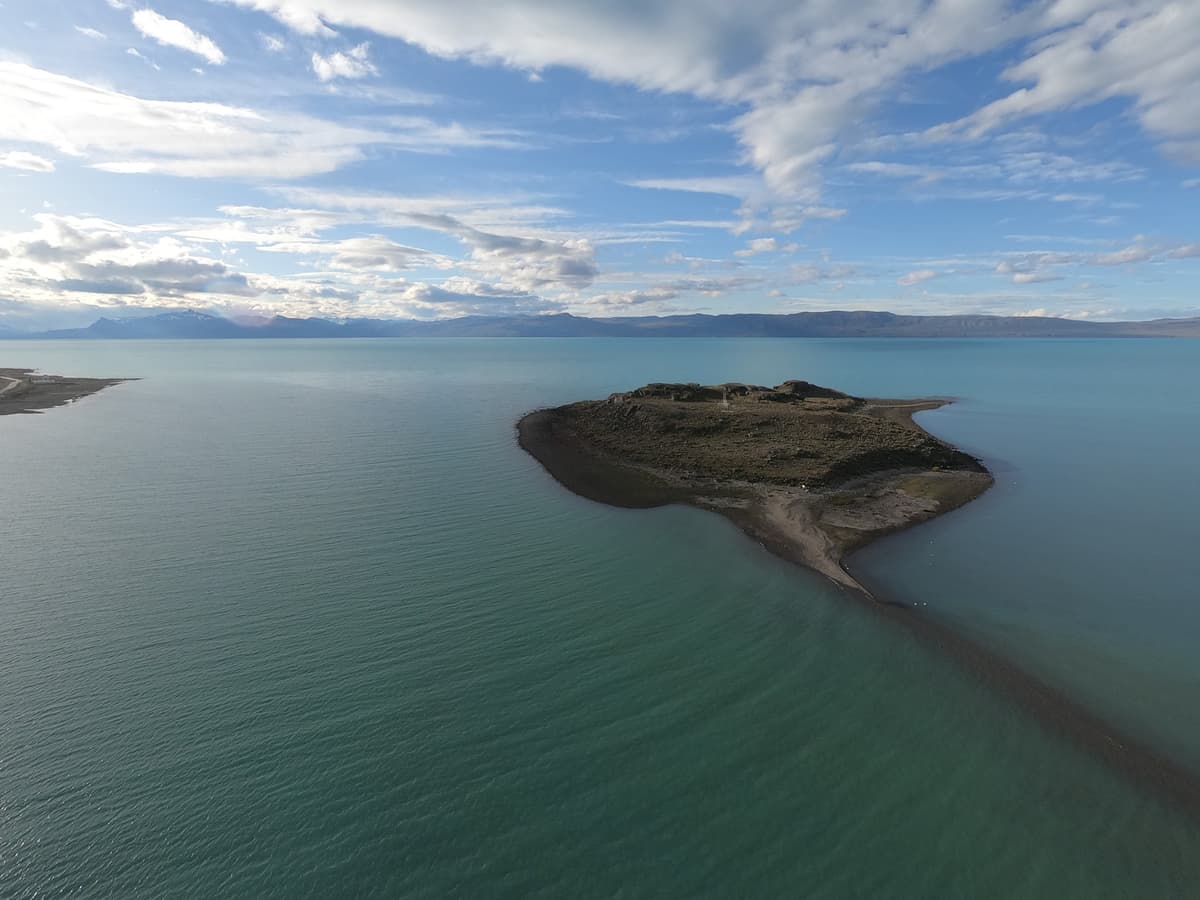
If you want to dig into what can be seen today from El Calafate's lakefront and its relationship with the lake Moreno named, we cover it in our piece on Isla Solitaria and Lago Argentino.
Why is it called the Perito Moreno Glacier? (and why Moreno never saw it)
The Perito Moreno Glacier is named after a tribute from Lieutenant Alfredo Iglesias to Francisco Pascasio Moreno: the name comes from the hydrographic survey Iglesias carried out in 1899 for the Argentine Hydrographic Institute, and his 1901 report already speaks of the "Perito Moreno Glacier." In other words: the name began to be used from 1899 and was formalized in the 1901 report.
Two clarifications that separate myth from history:
"Perito" is a job title, not a name or nickname. Francisco Moreno was the Argentine "perito" —the technical expert— of the Commission of Limits with Chile. The "P." in "Francisco P. Moreno" is not for "Perito": it stands for his middle name, Pascasio. The common mistake of saying "Francisco Perito Moreno" mixes the two things up.
It had other names before. Rogers, in 1879, had called it "Francisco Gormaz," in honor of Chilean hydrographer Francisco Vidal Gormaz. Later, geologist Rodolfo Hauthal named it "Bismarck," after the Prussian chancellor —a name that still appears on some old German maps. The name "Perito Moreno" finally took hold around 1899-1901.
Who was Perito Moreno
Francisco Pascasio Moreno (1852-1919) was an explorer, naturalist, and founder of the La Plata Museum. His most decisive role for Patagonia was as the boundary expert on the Commission of Limits with Chile: his fieldwork and his defense of the Argentine thesis were central to the 1902 arbitration award that defined much of the border. He also donated the lands that gave rise to Nahuel Huapi National Park. He died in 1919 and his remains rest on Centinela Island, in Lake Nahuel Huapi.
That's why his figure is so important in Patagonian toponymy —there is a glacier, a town, and a national park with his name— but it bears repeating in full: the glacier's tribute is posthumous with respect to his visit, because he never saw it.
Beware the geographic confusion: the Perito Moreno National Park, in northern Santa Cruz, is about 560 km from the glacier and is not the Perito Moreno Glacier. For years digital maps mixed up the two places, and there are still travelers who end up at the wrong destination. If your plan is to walk on the ice, the place is El Calafate, not the northern park.
Los Glaciares National Park and the UNESCO declaration
Los Glaciares National Park was created on May 11, 1937 through decree 105,433, first as a reserve and later ratified as a national park by Law 13,895. Its current boundaries were set by Law 19,292 of 1971, which divided the area into national park and national reserve. With some 726,927 hectares, it is the largest national park in Argentina.
Its goal was to preserve the continental ice of the Southern Patagonian Ice Field, the Andean-Patagonian forest (lenga, ñire, guindo), the steppe, and threatened wildlife such as the huemul. About 30% of the park's surface is covered by ice, and there are some 47 major glaciers.
In 1981, UNESCO declared Los Glaciares National Park a World Heritage Site, under criteria vii (superlative natural phenomena and exceptional beauty) and viii (glaciological processes). It was the first Argentine park inscribed on the list. The Perito Moreno Glacier, due to its accessibility and its rupture, ranks among the main reasons for that inscription.
We have a page with everything you need to know about Los Glaciares National Park if you want to understand how the visit works.
How El Calafate went from isolated town to tourism boom
The tourist history of the Perito Moreno Glacier is, in large part, the story of how it became accessible. In the late 19th century these lands were sold to ranchers dedicated to sheep farming and wool. El Calafate was founded in 1927 and, in 1943, the National Parks Administration began building the area's infrastructure.
For decades, getting there was an odyssey: you had to reach Río Gallegos and travel more than 300 km overland. The great turning point was the inauguration of El Calafate International Airport on November 17, 2000. From then on, the destination took off.
The numbers say it all: visits to Los Glaciares National Park went from about 100,000 in the year 2000 to around 770,000 in 2019, in direct correlation with the airport. In 2023 the park surpassed 700,000 annual visits for the first time. If you're interested in the detail by season and year, we have the full series in our El Calafate tourism statistics hub.
Today the glacier can be experienced in several ways, and they all leave from El Calafate:
- The walkways: a circuit of 4 to 5 km of trails about 300 m from the front, ideal for viewing it head-on without walking on the ice. It's the option suitable for all ages. We organize it in our Perito Moreno Glacier Tour, with the option of a boat trip in front of the north wall.
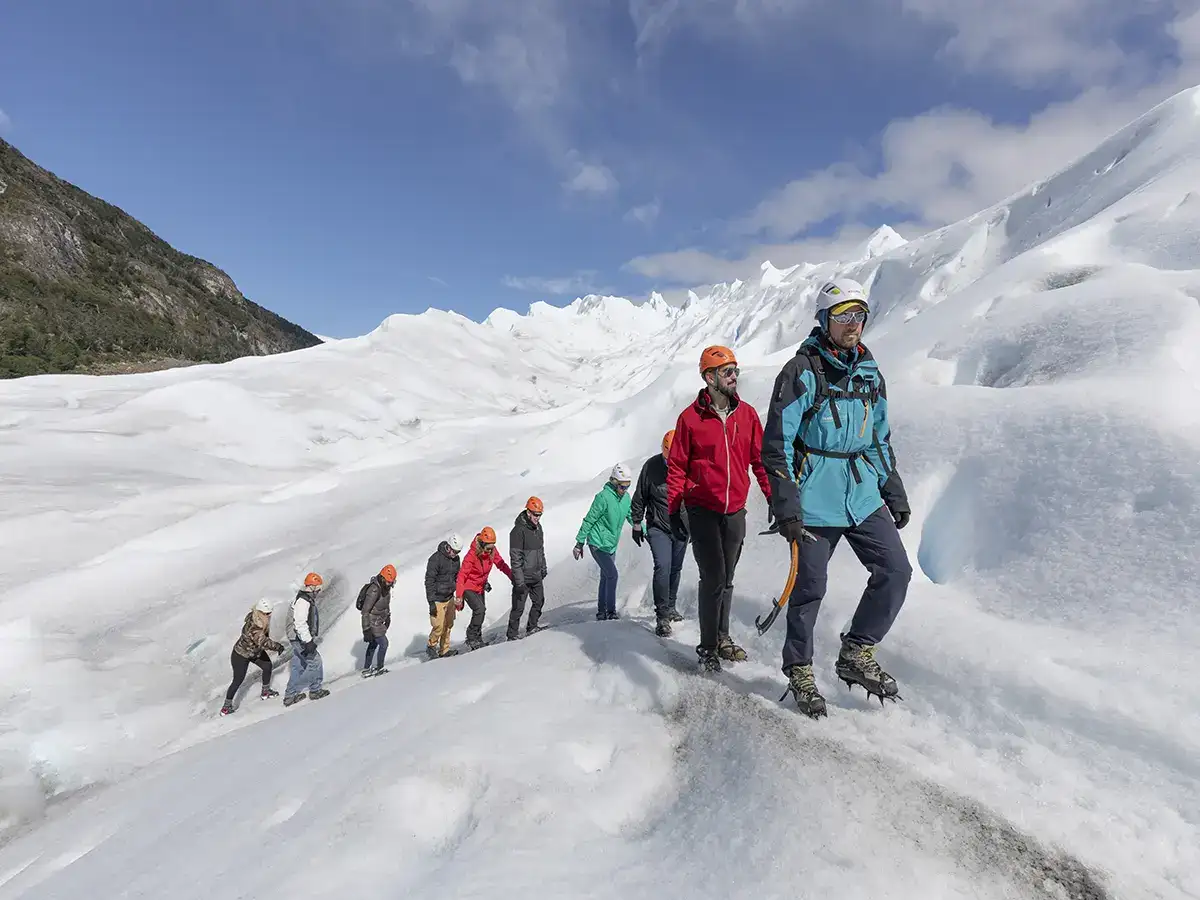
- Trekking on the ice: Minitrekking and Big Ice, walks with crampons on the glacier. If you're torn between the two, we compare them in depth in the Perito Moreno Glacier trekking guide.
- Boat trips on Lago Argentino: from Puerto Bandera, toward the Upsala and Spegazzini glaciers, like the Todo Glaciares excursion.
The rupture of the Perito Moreno Glacier: what it is and every date
The rupture of the Perito Moreno Glacier is the collapse of the ice bridge that forms when the glacier advances until it touches the Magallanes Peninsula and closes off the Brazo Rico of Lago Argentino. It is the phenomenon that made this glacier world-famous, and it's worth understanding well why it happens, because almost every blog explains it wrong.
How the ice dam forms
When the glacier's front advances and touches the Magallanes Peninsula, it forms an ice dam that separates the Brazo Rico (or Southern Arm) from the rest of Lago Argentino, in the area of the Canal de los Témpanos (Iceberg Channel). Since the Brazo Rico is left with no outlet, its level rises: historically it reached 23 to 28 meters above the main body of the lake.
Through pressure and flotation, the water detaches the base of the ice, infiltrates, and opens a subglacial tunnel that grows as its walls melt. When the tunnel is large enough, the ice bridge left on top collapses with an enormous roar. Here's the key few mention: it's not a simple mechanical fracture, but the erosion of the tunnel by water that ultimately destroys the dam.
Every recorded rupture date
The first recorded rupture was in 1917, the same period when the glacier first managed to close off the arm. Since then, the following have been documented, among others:
1917 · 1935 · 1940 · 1942 · 1947 · 1952 · 1953 · 1956 · 1960 · 1963 · 1966 · 1970 · 1972 · 1975 · 1977 · 1980 · 1984 · 1988 · 2004 · 2006 · 2008 · 2012 · 2013 · 2016 · 2018 (March 11) · 2019 (December 28, the last confirmed)
Two events deserve an asterisk: the rupture of March 11, 2018 was the largest of the 21st century (with the Brazo Rico 14.4 m above lake level), and the one on December 28, 2019 was atypical —small, with a record process of about 39 days— and is the last one confirmed by serious sources.
When does the Perito Moreno Glacier rupture?
The Perito Moreno Glacier has no fixed rupture cycle: the periodicity is irregular, ranging from a couple of years to more than a decade. The myth that "it ruptures exactly every 4 years" is false. In fact, between 1988 and 2004 16 years passed with no rupture at all, and there were fears the phenomenon had ceased. The recurrence is linked to the El Niño phenomenon (more snow and rain, more advance) and to topography. When it happens, it's usually in summer, although the 2008 one occurred in July, in the middle of winter, something unprecedented.
Beware the "2024 rupture" myth: the last confirmed rupture of the Perito Moreno Glacier is the one on December 28, 2019. There are no confirmed ruptures between 2020 and 2026. The alleged "2024 rupture" circulating on some travel blogs is false or confuses the seasonal advance of the ice with an actual breaking. Back in September 2023, the scientific director of the Glaciarium museum, Luciano Bernacchi, called a news item announcing a nonexistent rupture "nonsense."
So if someone promises you'll see "the rupture" on a specific date, be skeptical: the phenomenon can't be scheduled. What you can see all year round is the glacier's active front, with constant iceberg calving.
Myths and curious facts about the Perito Moreno Glacier
The history of Perito Moreno carries several myths. Here are the most common ones, corrected, plus some facts almost nobody knows:
- Myth: "Moreno discovered the glacier." False. Moreno named Lago Argentino in 1877, but never saw the glacier. The first European sighting was by Juan Tomás Rogers in 1879.
- Myth: "Perito is his name or nickname." It's a job title: the expert of the Commission of Limits with Chile.
- Myth: "It ruptures exactly every 4 years." The periodicity is irregular, with pauses of up to 16 years.
- Myth/nuance: "It's the only glacier in the world that's growing." What's accurate is that it maintained equilibrium for decades; it wasn't growing net, and today it's retreating.
- The calafate legend: "whoever eats calafate berries returns." It's a Tehuelche tradition and gives the town of El Calafate its name.
- Upsala and Viedma go the other way: the Upsala Glacier —the longest in the park, at about 53 km— and the Viedma Glacier have been retreating sharply for years. Perito Moreno was for decades the great regional exception.
- Moreno, amateur linguist: he took notes on the Tehuelche language and tried to compile a dictionary.
Is the Perito Moreno Glacier advancing or retreating? What science says in 2026
The Perito Moreno Glacier is retreating. After about 80 years of equilibrium, it entered a documented phase of retreat starting in 2019, and the tourist narrative of "the glacier that grows while the others shrink" is now outdated.
The reference study was led by glaciologist Moritz Koch, together with Pedro Skvarca (of the Glaciarium museum) and Lucas Ruiz (of IANIGLA-CONICET), and was published in August 2025 in the scientific journal Communications Earth & Environment. These are the verifiable figures it provides:
| Indicator | Before | Since 2019 |
|---|---|---|
| Thinning of the front | 0.34 m/year | 5.5 m/year (multiplied by more than 16) |
| Retreat of the front | ~100 m total (2000–2019) | ~700 m per year (2021–2023) |
According to the study, the thinning of the front multiplied by more than 16 from 2019, and the glacier retreated at a rate of about 700 meters per year between 2021 and 2023, especially on the northern margin. The front is today very close to flotation over the submerged rocky ridge of the Canal de los Témpanos, and its contact with the Magallanes Peninsula is increasingly weak.
Does this mean the glacier will disappear tomorrow? No. What the scientists say is more nuanced: Perito Moreno has stopped being in equilibrium, has been retreating since around 2019-2021, and its recovery is unlikely in a context of climate change. But it's still standing, still a spectacle, and still in contact with the peninsula. The scenarios of "catastrophic disconnection" and rapid retreat of several kilometers are hypotheses expressed in the conditional by glaciologists —they would occur if the glacier lost its anchor on the ridge— not accomplished facts.
Perito Moreno's retreat still doesn't reach the magnitude of Upsala or Viedma, but the trend is the same one affecting almost all Andean glaciers. It's part of a broader debate about the protection of Patagonian ice, which in Argentina runs through the Glacier Law.
Want to visit the Perito Moreno Glacier with local experts?
You've read the history; now come see it. At Calafate Tours we're guides and residents of El Calafate, and we plan your visit to the Perito Moreno Glacier with official rates and direct booking, no middlemen. We help you choose between the walkways, trekking on the ice, or a boat trip on Lago Argentino based on your time and your group.
Frequently asked questions
Frequently asked questions about the history of the Perito Moreno Glacier
Resolvemos las dudas más comunes.
Last updated: June 9, 2026. Scientific data based on the study by Koch et al. (2025), published in Communications Earth & Environment*, and on official sources (APN, UNESCO, IANIGLA-CONICET). Verify current details for volatile data before traveling.*